Volume still wins. Sameness just doesn't count
Meta's retrieval engine reads the creative itself to decide who sees an ad, and it groups near-duplicates into one entity. The platform genuinely rewards feeding it a lot of creative. What it will not reward is a lot of the same creative.
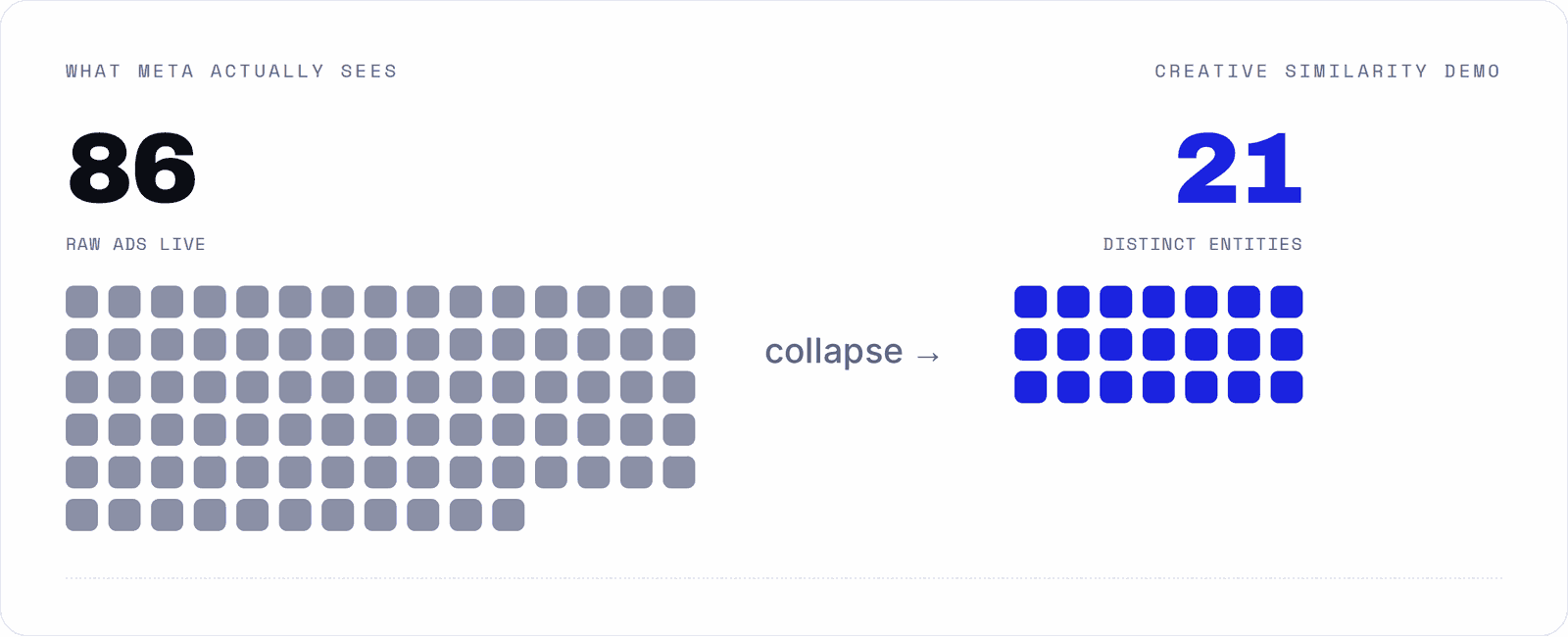
Raw volume of cosmetic variations, ten cuts of one video, the same static in nine cities, gets collapsed back down. In one real campaign, 86 live ads resolved to 21 distinct entities. You are paying to produce ads the auction never really sees.
The goal is both at once: high volume, high variety. A large library of ad units that are actually distinct from each other. That is what the modern auction is starving for, and what most accounts are not feeding it.
So we built a scorer
It measures whether your volume is varied or just big. We pull an account's live creative, collapse cosmetic variants down to distinct concepts, and score six layers: concept, copy angle, production style, creator, hook, and persona. Each layer counts the genuinely distinct variations, then docks points for concentration, the same way the auction collapses look-alikes.
Lesson one: score by campaign, not account
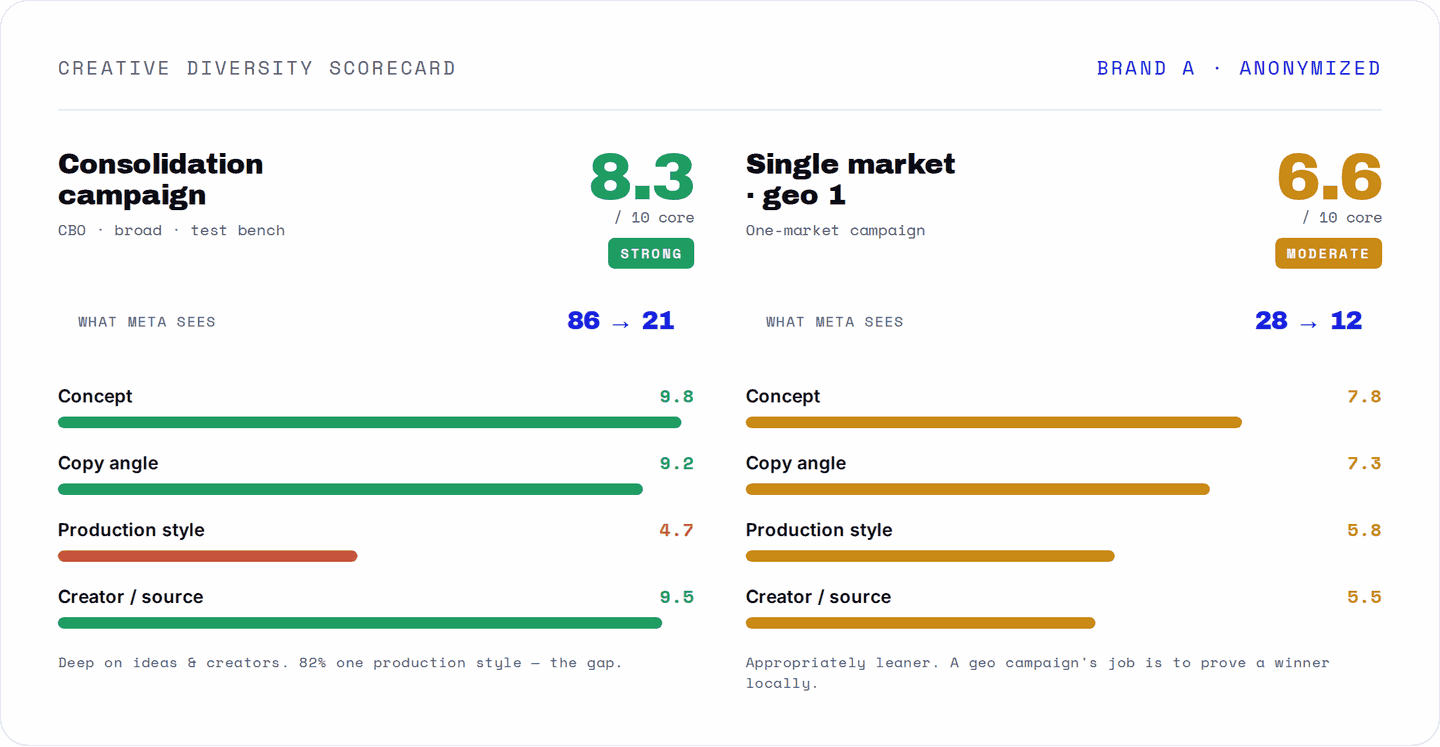
The first version scored a whole account, and it was wrong. If you run one market's campaign and another's with the same core creative localized, that is not sameness. It is correct targeting. Two ads that never enter the same auction cannot collapse into each other. Measure variety inside the pool where ads actually compete: your consolidation campaign should be richest, and a single market can run leaner.
Lesson two: it's the styles, not the formats
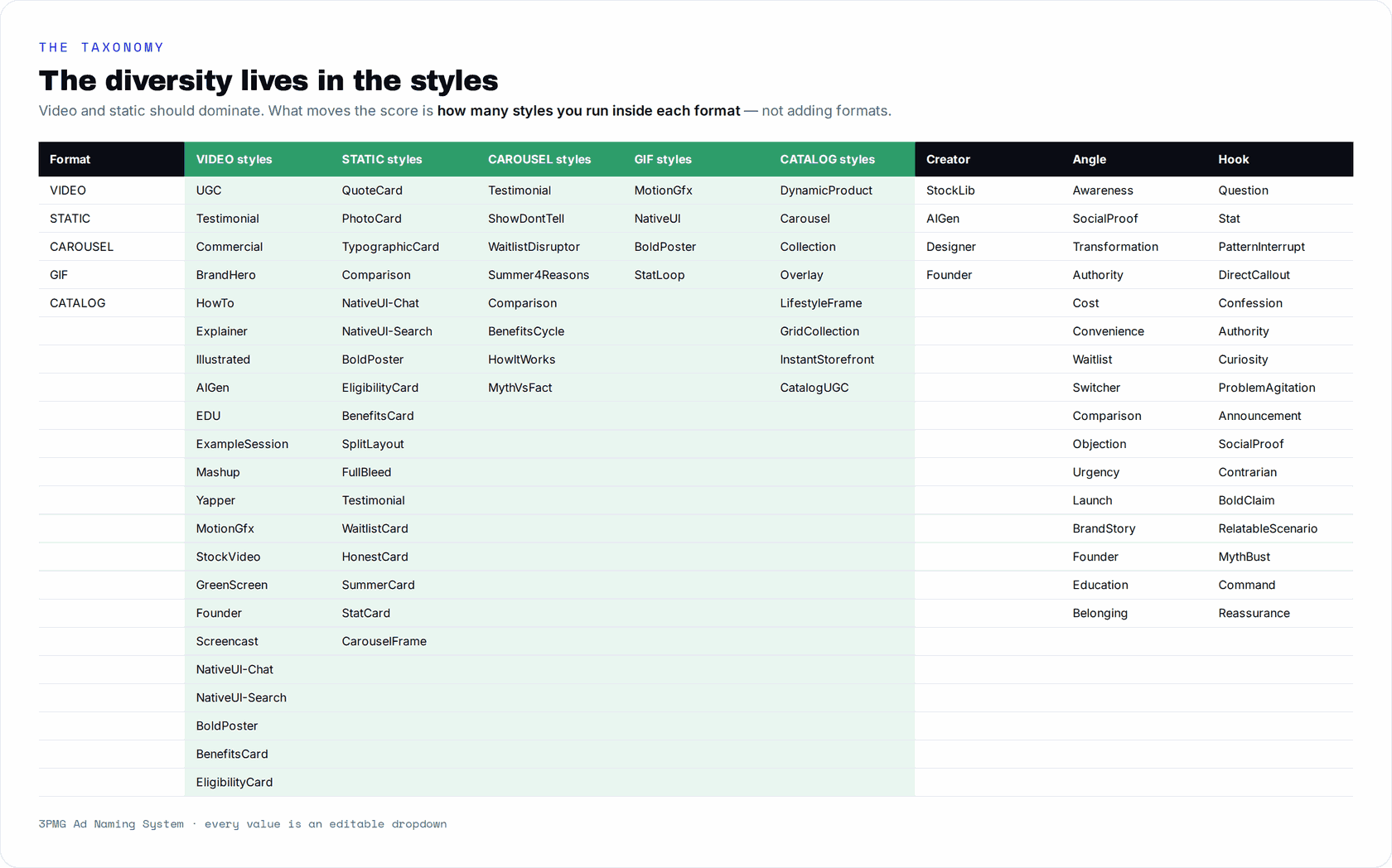
Variety does not mean adding formats. Video and static are the workhorses, and the mix usually skews static-heavy, roughly 60/40 static to video. That split is fine. The lever is the variety of styles within each format.
For video that is not just UGC. It is UGC and testimonials and explainers and founder pieces, each a different production style the auction reads as new. For static it is quote-cards, photos, typographic cards, comparisons, and native-UI mockups. The strong account we scored had a deep bench of creators and angles but rendered about 82 percent of its volume as one style. The fix was never a new format. It was more styles inside the 60/40 it already ran.
One exception if you sell products: catalog ads. For an ecommerce brand, dynamic catalog ads are their own format and their own lever, not a style you fold into video or static. Run them alongside your prospecting creative. If you are a service or lead-gen brand, you can skip them.
Lesson three: some layers you feed
Format, angle, creator, and concept read straight from the data. Hook is different. Nothing transcribes the first three seconds of a video, so hook scoring only works if you keep the scripts. Static style can be read from the pixels with a quick pass, but video style cannot be read frame by frame. An honest tool tells you which layers are measured and which need your input.
Diversity is a gate, not a strategy. A varied library of things that do not convert is not the goal. You still have to find what actually works and lean into that.
The real loop: find the winners, pull cost-per-result and see what converts, then build variety within the winner. New hooks. New styles. New pace. Iterate the winners, introduce experiments, expand the variety around what already earns. Diversity for its own sake still has to clear your CAC bar.
None of this works without a naming convention
Every layer reads from one place first: the file name. Name your creative with a disciplined convention and it can be scored on style, creator, angle, and market straight from the folder. Name it "Copy of Copy of final_v3" and it cannot be scored on anything.
The name is nine parts
- Format VIDEO / STATIC / CAROUSEL / GIF / CATALOG.
- Lang EN / ES.
- Style the production style, and it depends on the format. Video styles are a different list from static styles. The layer most accounts never tag, and the one that moves diversity most.
- Creator the person or source (a creator name, StockLib, AIGen, Designer).
- Angle the argument the ad makes (waitlist, cost, social proof, switcher).
- Month MonYY, like Jul26, for recency and fatigue tracking.
- ID a code plus the variant number (UGC210-2). The variant rides here on purpose.
- Geo a short market code (HOU, DAL, ALL). A free write-in, since markets change.
- Ratio 9x16 / 1x1 / 4x5 / 16x9. Sits dead last, on purpose.
Render goes last so sizes stay together. Filenames sort left to right. Put the concept identity first and the render attributes last, and every size and market cut of one ad shares an identical prefix, landing side by side in the folder instead of scattering.
Hook type is not in the name. You keep a row per hook variant, so hook type lives as a catalog column, not a filename segment. That keeps variants adjacent and still lets the scorer read the hook from the sheet.
How to organize the catalog
One row per hook variant. The filename is for the folder; the catalog is the source of truth. It carries the same fields plus the parts a filename cannot hold: the hook copy, the full script, and a link to the asset.
VIDEO_EN_BrandHero_Founder_BrandStory_Jan26_HERO001-1_ALL_9x16
VIDEO_EN_UGC_Dana_SocialProof_Jan26_UGC004-2_ALL_9x16
VIDEO_EN_Explainer_Designer_Education_Feb26_EXP002-1_ALL_1x1
STATIC_EN_QuoteCard_Designer_SocialProof_Jan26_TES001_ALL_1x1
CAROUSEL_EN_Comparison_Designer_Comparison_Feb26_CAR003_ALL_1x1
↓ Download the working template (.xlsx)
Two free tools to build the foundation
The workbook gives you the catalog. Two skills run the system. Each drops into Claude and installs with a click, and both are open source on GitHub.
The ad naming system
Interviews you about your brand, then generates your workbook: convention, a name builder, a catalog that doubles as your script and hook database, and an editable taxonomy.
↓ DownloadThe creative diversity scorer
With Meta connected, pulls one campaign's live creative and scores its variety across six layers, campaign by campaign, and shows what the auction actually sees.
↓ Download↓ Download the whole repo (.zip)
Both skills are open source under MIT. Browse or star the repo on GitHub.
Want us to run this on your account?
The scorer, the pixel pass, and the naming system are the kind of systems most brands never get around to building. That is the whole idea behind 3PMG: senior marketing leadership without the full-time overhead. Book a call at 3pmg.co.
Let's build your third pillar.
Product and operations are handled. If marketing is the missing piece, let's talk.