TL;DR
Most marketing teams have quietly adopted a role they never wrote a job description for: the person who reviews AI output. Scott Brinker's point this week is that "human in the loop" describes two completely different arrangements: a domain expert with the time and authority to kill work, and an overloaded person clicking approve on a queue they cannot assess. Only one of those is a control. Which one you have is not a tooling question, it's a staffing and org-design question, and the arithmetic is brutal: at six honest minutes per item, a reviewer with four hours can meaningfully assess forty things, not two hundred. Every's Thesis Statements collection, 25 builders finishing the sentence "After automation: ___," lands in the same place from a different direction. Value is moving from output to specification, judgment and the nerve to say no. This post covers Brinker's three questions as a hiring spec, what the collection says about who you should be hiring, and four things to change in how your marketing team is structured.
The role nobody wrote a job description for
Go and read your own job postings. Or the last three you filled.
If any of them ask someone to "review AI-generated content," or "own quality control on the creative pipeline," or "act as final approver before launch," you have already made an org design decision. In most companies I look at, nobody made it on purpose. The line got added because the pipeline got faster and somebody had to be accountable for what came out of it.
That line describes two entirely different jobs, and the difference between them is the whole ballgame.
Scott Brinker wrote a piece this week taking apart the phrase everyone now reaches for to sound responsible about this: human in the loop. His argument is that the phrase covers wildly different arrangements. A domain expert with real authority to reverse a decision is one thing. An overloaded person clicking approve on a queue they cannot meaningfully assess is another. Both get called human in the loop. Only one of them is a control. The other is a rubber stamp with a job title.
Brinker leaves three questions behind, and they are the most useful thing published in martech this month:
- Which human? Named, with what domain expertise, and with what actual authority to stop the thing.
- How much attention? Not "reviews the work," but how many minutes of genuine assessment, per item.
- Where in the loop? Relative to the step you cannot undo. Before spend, before send, before the brand is committed.
Read those again as a marketer rather than as a technologist. They are not tooling questions. Question one is a job description. Question two is a headcount and calendar question. Question three is a process map. Not one of them gets solved by buying something.
Which is why this lands on the CMO's desk and not the platform team's. And why, if you don't have a marketing leader, it currently isn't landing on anyone's.
Run the arithmetic before you run anything else
Here is the number almost nobody has calculated.
A reasonably well-built AI creative pipeline produces somewhere north of a hundred usable assets a week: ad variants, landing page copy, lifecycle emails, social cuts, a dozen versions of each. That figure is not aspirational. Founders we work with are hitting it now, with tools they already pay for.
Now answer Brinker's second question honestly. Who reviews that, and how long do they actually have? In most companies the true answer is one person, part of a day, wedged between other work.
Do the multiplication. Four hours of reviewer time, at six honest minutes to assess one item against a brand, an audience and a strategy, gives you a real reviewed throughput of forty. If you're generating two hundred, then a hundred and sixty items a week are shipping with nobody meaningfully looking at them.
And here is the part that makes it hard to catch: nothing breaks. The work ships. It is on brand. Nobody complains. It just quietly stops doing anything.
That failure has no alarm attached to it, which is precisely why it needs a number attached to it instead. Publishing your real reviewed-throughput figure usually ends the internal argument about whether to generate more, in about ninety seconds.
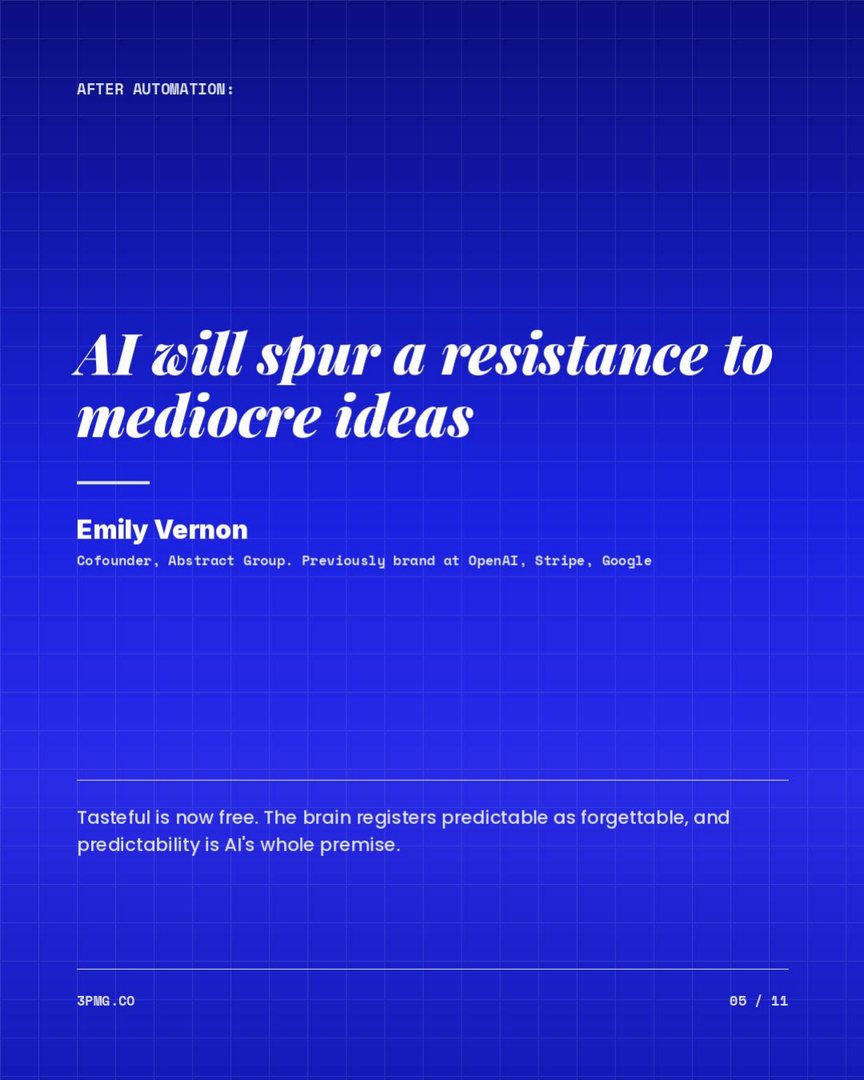
There is a second reason the volume doesn't help. Emily Vernon, who led brand at OpenAI, Stripe and Google, put it plainly in her Thesis Statement: AI makes mediocre ideas irresistible. Why spend six figures and six months on brand when you can generate something passable, even tasteful, from a few prompts for free? So you are scaling competent output at the exact moment competent output stopped differentiating anything. The pipeline outran the reviewer, and the thing it's producing more of was already losing its power.
What the collection says about who you should hire
Thesis Statements is a project from Every, running alongside their Thesis: 2027 conference at Pioneer Works in November. The format is deliberately constrained: 100 builders and thinkers each finish one sentence, "After automation: ___." Twenty five are live.
I found it because Nathaniel Whittemore built a Sunday Long Reads episode of The AI Daily Brief around the first batch. He's right that the collection is notable for finally getting specific. This is not the tired argument about whether AI takes jobs, it's a set of concrete claims about where human value relocates when competence becomes free.
What struck me on reading all 25 is how many of them are, underneath, arguments about staffing.
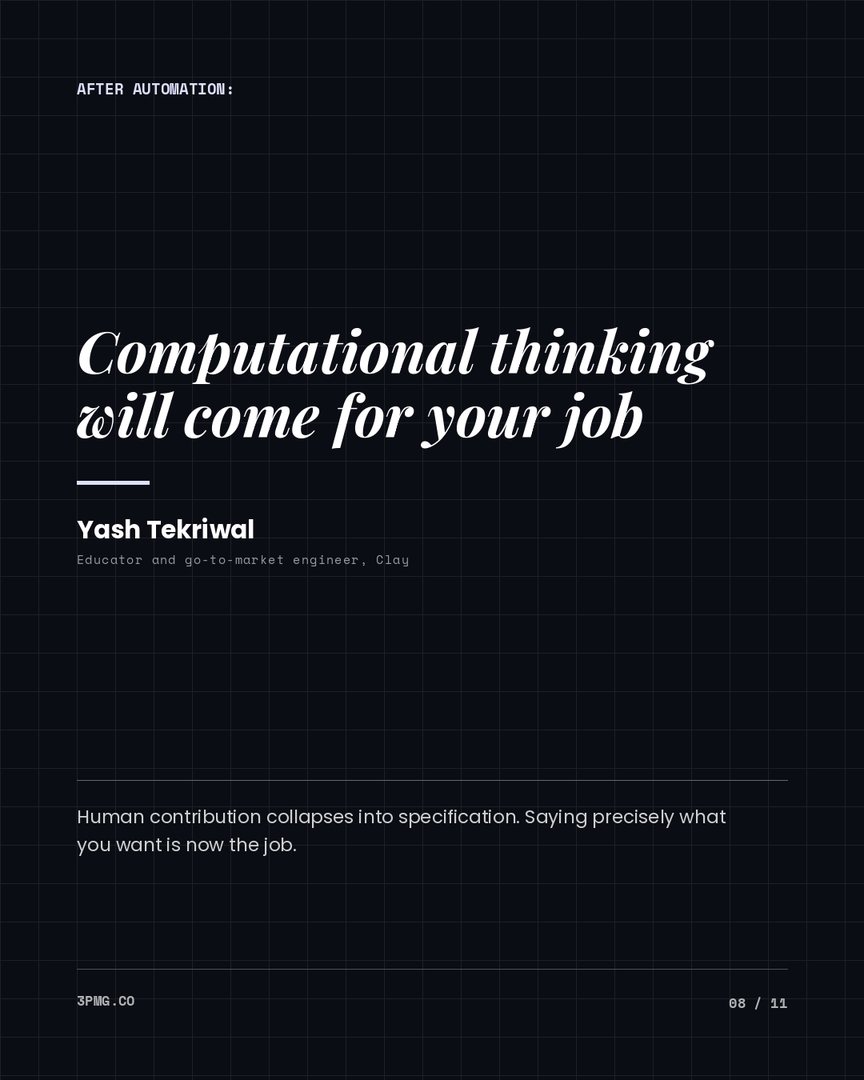
Yash Tekriwal, Clay: "Computational thinking will come for your job." His mechanism is the most directly useful thing in the collection for anyone writing a job description. When agents handle execution, human contribution collapses into specification. The person who can state precisely what they want, in a form a machine can act on, "does the work of 10 people who just know things." His sharper version: "Lazy writing has always been lazy thinking, and prompting AI is no different." Note that this is a testable competency. You can give a candidate a vague objective and see whether they can turn it into a spec. You could never test "is creative" that way.
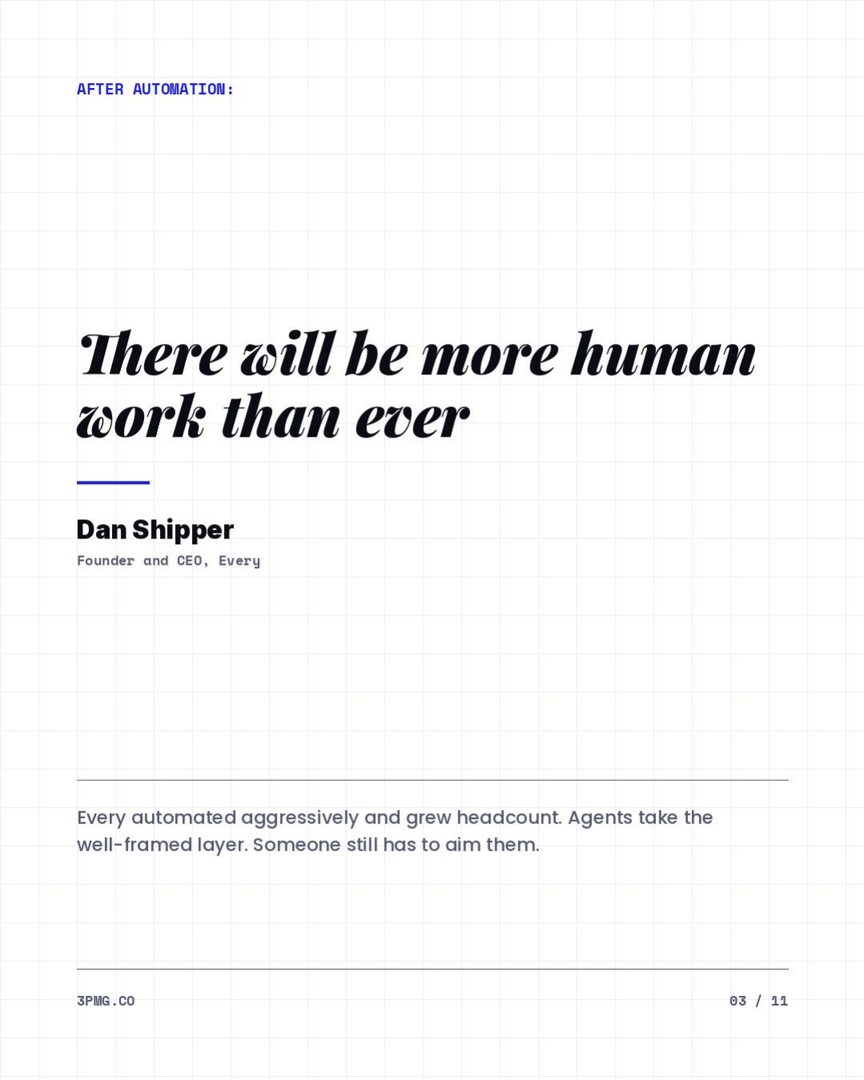
Dan Shipper, Every: "There will be more human work than ever." Every runs about thirty people, automated aggressively, and has not replaced anyone with agents. His mechanism: AI trains on whatever expertise can be made explicit, which collapses the value of default model output, so demand for what is different is demand for human experts. And the line to keep: models only know about work that has been done; humans know what needs to be done right now.
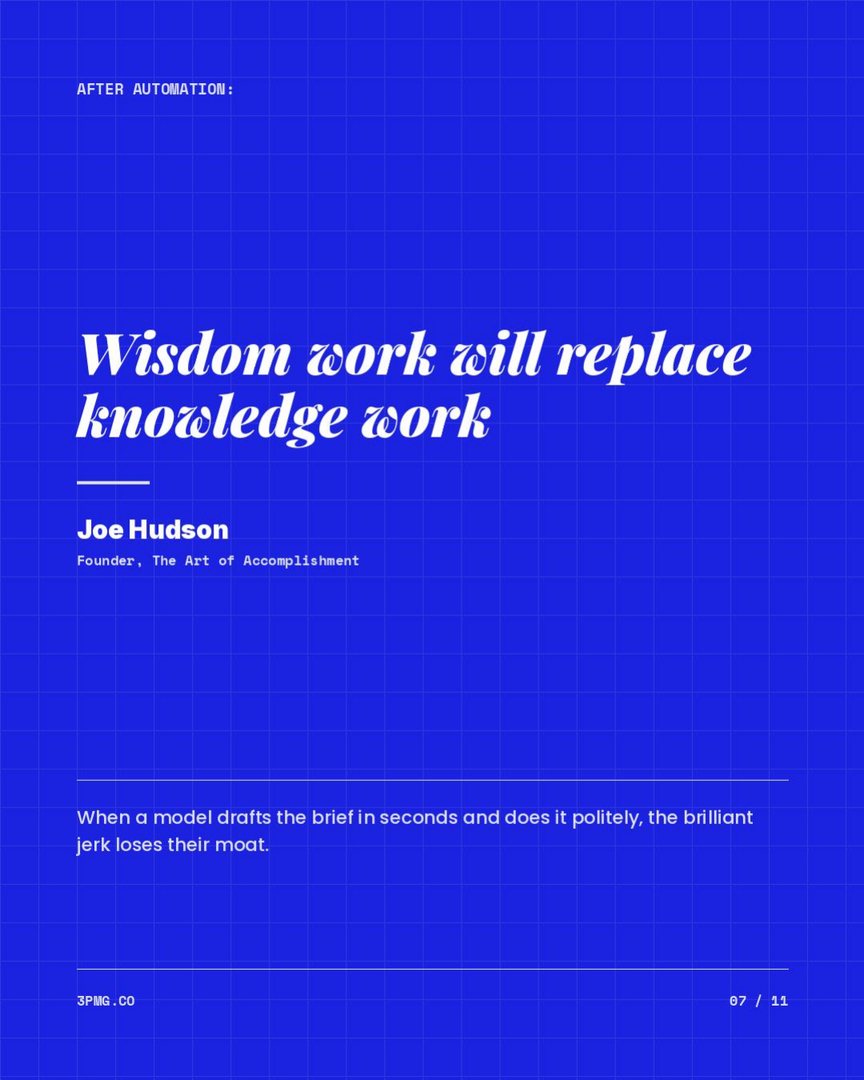
Joe Hudson, The Art of Accomplishment: "Wisdom work will replace knowledge work." With a corollary that should worry a specific kind of high performer: when a model can draft the brief, diagnose the anomaly or optimise the strategy in seconds, and do it politely, there is no reason left to pay the emotional tax of a brilliant jerk. This is a retention argument as much as a hiring one.
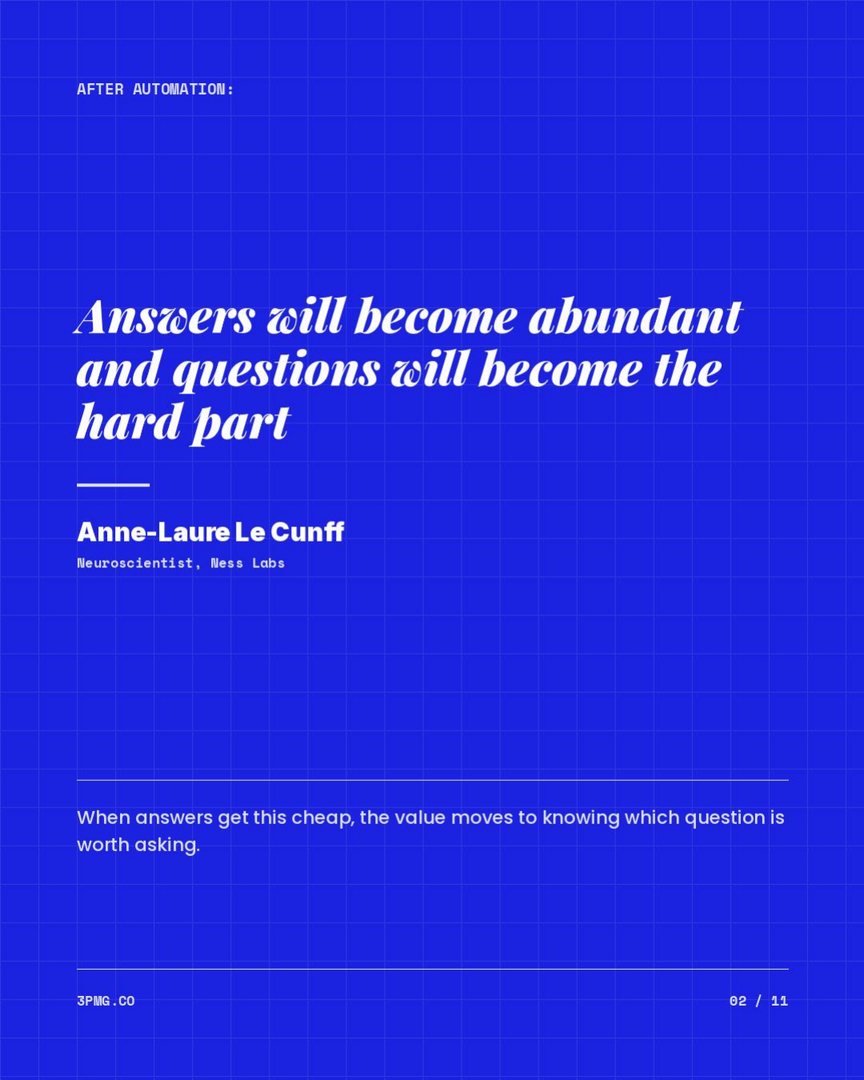
Anne-Laure Le Cunff, Ness Labs: "Answers will become abundant and questions will become the hard part." Her closing claim is a team-quality claim: the strongest teams will not be those that automate the most work, but those that ask the best questions.
Shoshana Berger: "Aged intelligence will be worth more than artificial intelligence." She opens with a New York Times editor reading her lede back to her and saying "are you kidding me." She cried, took the notes, rewrote it fifty times. Her point is that having masterful tools is not the same as having mastery, and that if we stop apprenticing the next generation, everything stops learning, including AI. If you are wondering whether to keep hiring juniors in an AI-heavy team, she and Willem Van Lancker both argue hard that you must, or you get "a beige hellscape of sameness."
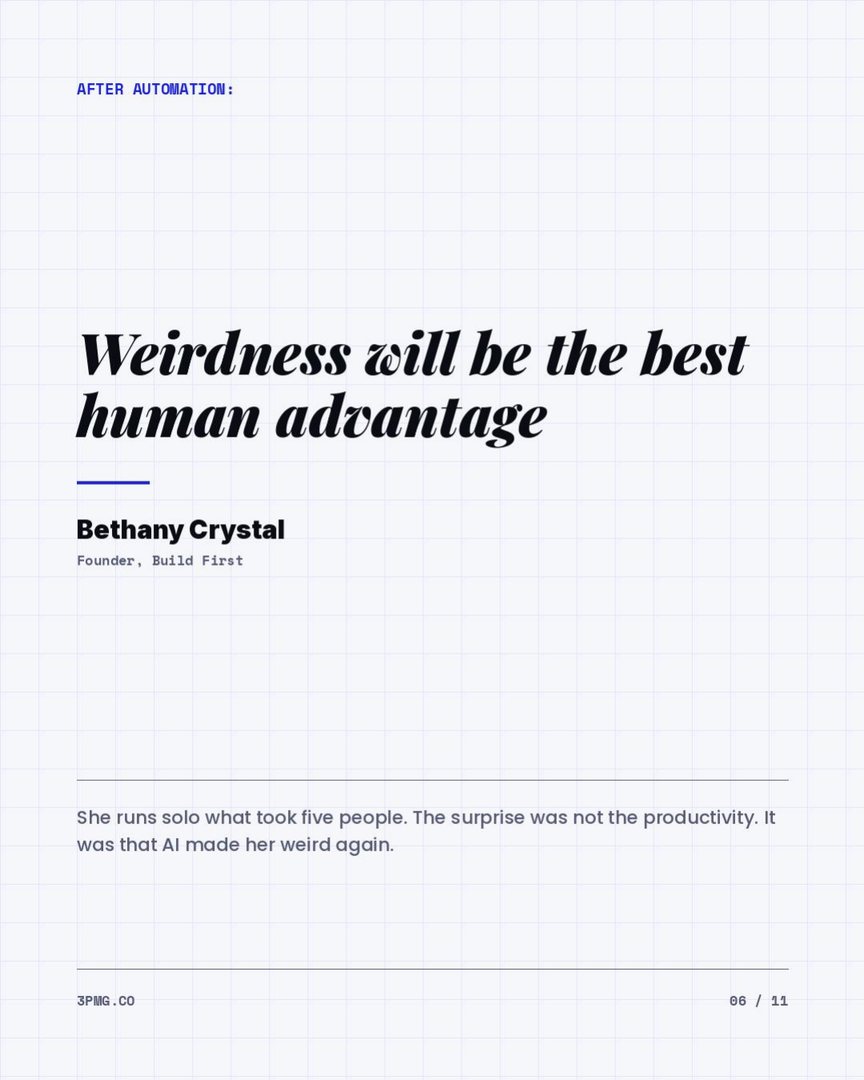
Bethany Crystal, Build First: "Weirdness will be the best human advantage." She runs solo what would have taken five people, and says the surprise was not the productivity. It was that AI made her weird again.
Read together, these describe one movement, and it is a staffing movement. Machines took the muscle, then the routine, and now the competent. What is left is specification, judgment, taste and nerve, and those live in people, at a specific point in a process, on a calendar.
Four things to change on Monday
1. Answer Brinker's three questions in writing, for every AI workflow that touches a customer. Which named human, how many minutes of genuine attention per item, and where in the sequence relative to the irreversible step. Then publish the multiplication. If your reviewer has four hours and each item needs six real minutes, your throughput is forty, not two hundred, and the other hundred and sixty are shipping unreviewed. Say so out loud. Most teams have never done this arithmetic, and it usually ends the argument about generating more.
2. Rewrite the review job so it happens before generation, not after. Reviewing two hundred finished assets is the lowest-value place to spend your best judgment, because by then every meaningful decision is already baked in. The same person spending those hours on which four concepts are worth making at all changes the outcome far more. Judgment applied before generation compounds. Judgment applied after generation is inspection, and inspection scales badly. Practically: the job title changes from approver to briefer, and something comes off their plate to make room.
3. Hire and interview for specification, not portfolio volume. Tekriwal's claim has a hiring test attached to it. Give a candidate a fuzzy business objective and ask them to turn it into a brief a model could execute against. Ask them to show you something they killed, not something they shipped, something good enough to ship that they decided not to make. Volume of past output tells you almost nothing now. Ability to specify and willingness to reject tell you nearly everything.
4. Put a strangeness quota in the brief, and give someone the authority to enforce it. Every concept set gets a test: would a competent model have suggested this from a generic prompt describing our category? If yes for all of them, the set is competent and forgettable. Set a hard floor: one in four concepts must fail that test and must be defended on a point of view rather than on performance data that does not exist yet. This is uncomfortable, which is the point. It is also the only line item protecting you from converging on exactly what your competitors' models are producing from exactly the same prompts. A quota with no named enforcer is a wish.
Prompt to get you started
Want to run this on your own team? Start with this prompt in Claude. It turns the four moves above into an audit you can complete in about an hour, and it will give you your real reviewed-throughput number rather than your theoretical output number.
You are a fractional CMO auditing a marketing team that has
adopted AI production faster than it has adapted how it is
staffed. Be direct. I want decisions, not encouragement.

Context you need from me, ask for anything I leave blank:
- Business: [what we sell, to whom, price point]
- Team: [roles, headcount, who reviews creative, seniority]
- AI pipeline: [what we generate, with what tools, volume
  per week]
- Review: [who reviews, how long they actually have, at
  what point in the process, what authority they have to
  reject]
- Where creative briefs come from: [competitor libraries,
  customer research, sales calls, other]
- Recent creative performance: [what is working, what
  has flattened]

Work through these five steps in order.

1. ATTENTION BUDGET. Calculate my real reviewed
   throughput: reviewer hours available, divided by the
   honest minutes required to assess one item. Compare
   that to what we actually generate. State the gap as a
   number and tell me what is shipping unreviewed.

2. LOOP AUDIT. For each AI workflow touching customers,
   answer Scott Brinker's three questions: which named
   human, how much attention per item, where in the
   sequence relative to the irreversible step. Flag every
   workflow where the answer describes a rubber stamp
   rather than a control.

3. JUDGMENT PLACEMENT. Identify where my best judgment
   is currently spent. If it sits after generation,
   redesign the workflow so it sits before. Show me what
   that person stops doing to make room, and what their
   job title should actually be.

4. HIRING SPEC. Write the job description for the role
   this team actually needs next, based on the gaps above.
   Include three interview exercises that test the ability
   to specify and the willingness to reject.

5. STRANGENESS AUDIT. For my last ten concepts, assess
   which a competent model would have produced from a
   generic prompt describing my category. Give me the
   ratio. Then propose three concepts that would fail
   that test, each defensible on a point of view rather
   than on past performance.

Output a prioritized action list. Each item needs an owner
role, an effort estimate in hours, and what specifically
gets worse if we do nothing. Do not summarize the
framework back to me.

Ask me one clarifying question at a time when you need
more information.
If you want a version of this already loaded with your positioning, your competitive set and your actual org chart, that is the kind of starting artifact we build for our fractional-CMO clients.
What this means if you lead a marketing team
The instinct when output gets cheap is to produce more of it, and to think of the human as a safety net stretched underneath. Every incentive in a growth org points that way. The platforms reward volume. It feels like the obvious move.
The argument running through Brinker's piece and through this whole collection is that the human is not a safety net. The human is the part that decides what gets made, and where you put that person in the sequence, how much of their calendar you protect, and what you empowered them to say no to are the three most consequential decisions in your marketing function right now.
None of that can be bought. All of it shows up in a budget as a person rather than a line item. It is also, we think, the whole game now. The teams that will look impressive in eighteen months are not the ones generating the most. They are the ones who put their best judgment before the work instead of after it, and then had the nerve to make something a model would not have suggested.
Key takeaways
- "Human in the loop" describes both a real control and a rubber stamp. Brinker's three questions separate them: which human, how much attention, where in the sequence.
- All three questions are staffing and process questions. None of them is answered by buying a tool.
- Do the multiplication. Reviewer hours divided by honest minutes per item is your real throughput. Everything above it ships unreviewed, and nothing visibly breaks when it does.
- Judgment applied before generation compounds. Judgment applied after generation is inspection, and inspection scales badly. The review role should move upstream and change its title.
- Hire for specification and for the willingness to reject. Both are testable in an interview. Volume of past output is no longer informative.
- Competent stopped being a differentiator, so a reviewer who only enforces "on brand and correct" is raising volume, not quality.
Every has an open submission on the project. Anyone can finish the sentence. If you are running a marketing function through this shift and want to think the staffing through properly, book a call.
Sources
- Scott Brinker, "Not all humans-in-the-loop are equal": https://newsletter.chiefmartec.com/p/not-all-humans-in-the-loop-are-equal
- The AI Daily Brief (Nathaniel Whittemore), "The Real Future of AI and Work": https://aidailybrief.ai/e/2026-08-23
- Every, Thesis Statements (the full collection): https://every.to/thesis-statements
- Yash Tekriwal, "Computational thinking will come for your job": https://every.to/thesis-statements/yash-tekriwal
- Dan Shipper, "There will be more human work than ever": https://every.to/thesis-statements/dan-shipper
- Joe Hudson, "Wisdom work will replace knowledge work": https://every.to/thesis-statements/joe-hudson
- Anne-Laure Le Cunff, "Answers will become abundant and questions will become the hard part": https://every.to/thesis-statements/anne-laure-le-cunff
- Shoshana Berger, "Aged intelligence will be worth more than artificial intelligence": https://every.to/thesis-statements/shoshana-berger
- Willem Van Lancker, "Seeking productive friction will lead to your biggest successes": https://every.to/thesis-statements/willem-van-lancker
- Emily Vernon, "AI will spur a resistance to mediocre ideas": https://every.to/thesis-statements/emily-vernon
- Bethany Crystal, "Weirdness will be the best human advantage": https://every.to/thesis-statements/bethany-crystal
Let's build your third pillar.
Product and operations are handled. If marketing is the missing piece, let's talk.